An early issue the EleVATE Collaborative grappled with was whether this work should include a research component.
The debate was heated because of past and present abuses and injustices based on research in our communities, and a history of researchers coming in, taking what they needed, and never returning what was learned to the community or using it to benefit the community, such as through policy change.
As a collaborative, we ultimately decided to make research an integral part of this work.
Research lets us tell the story, so that:
We can share our collaborative process, how we achieved our outcomes, and what worked and what didn’t
People coming after us can replicate the model
We show how research can impact communities, advance racial equity and be done equitably
Our approach
How we do research differently
Trauma-informed, community-based participatory research
Applying the principles of: Choice, Trust, Collaboration, Empowerment
Working actively with community members
Through equitable decision-making and shared goals and values.
Radical listening and accountability
Working together to radically listen and be accountable to our communities and collaborative members.
2016-2018
EleVATE Pilot
SITES:
Affinia Healthcare
Barnes-Jewish Hospital
St. Mary’s Hospital
The pilot was a feasibility study to understand EleVATE implementation factors, learn how to implement the EleVATE group prenatal care model, and identify whether our evaluation captured changes in both qualitative and quantitative data. The pilot was a small group of patients and was not statistically significant, but the results indicatedpositive outcomes for maternal and infant health.
What health care team members told us
Themes from interviews with team members who facilitated EleVATE groups:
Increased comfort facilitating discussions on implicit bias
Improved active listening and skills to integrate behavioral health tools
Used tools to address power dynamics between patients and team members for more equitable, respectful care
Increased understanding of how racism and discrimination impact health outcomes
Advanced self-reflection and understanding of racial identity without perpetuating harm
Adopted policy and practice changes to support trauma-informed care
What patients told us
From interviews with EleVATE group prenatal care patients, 4–12 weeks postpartum:
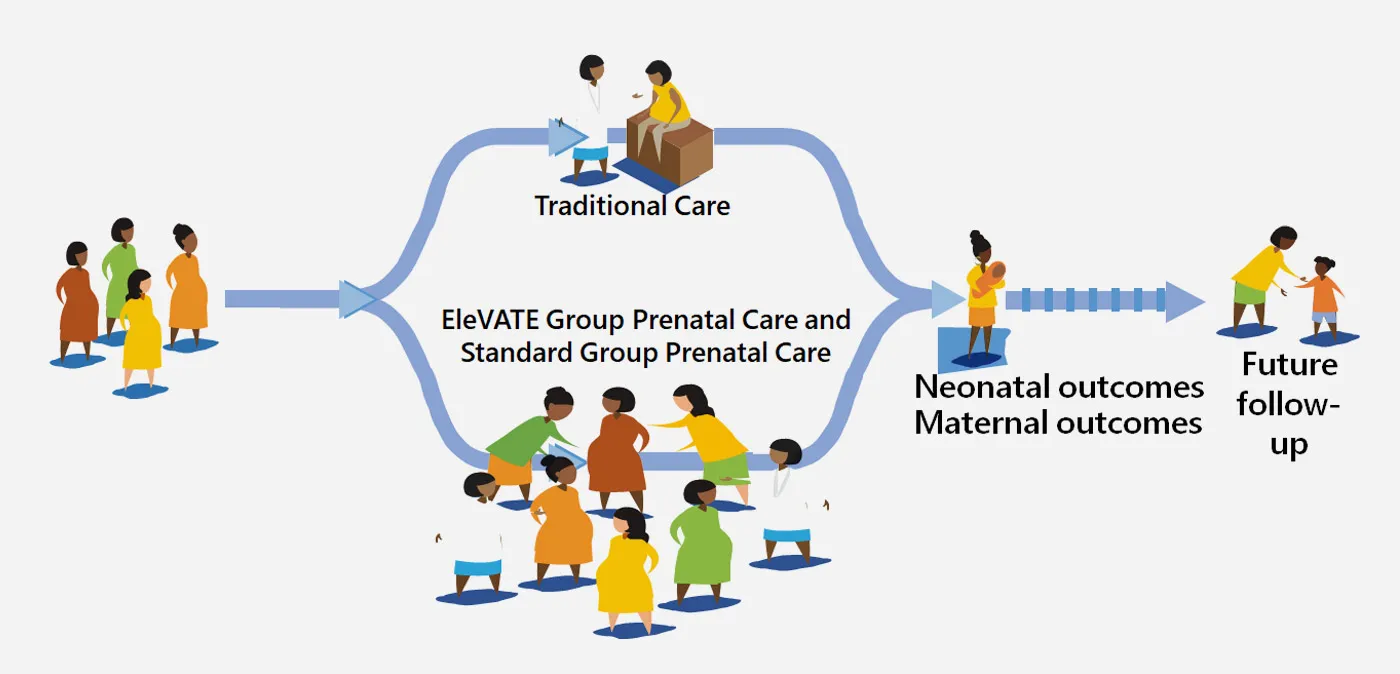
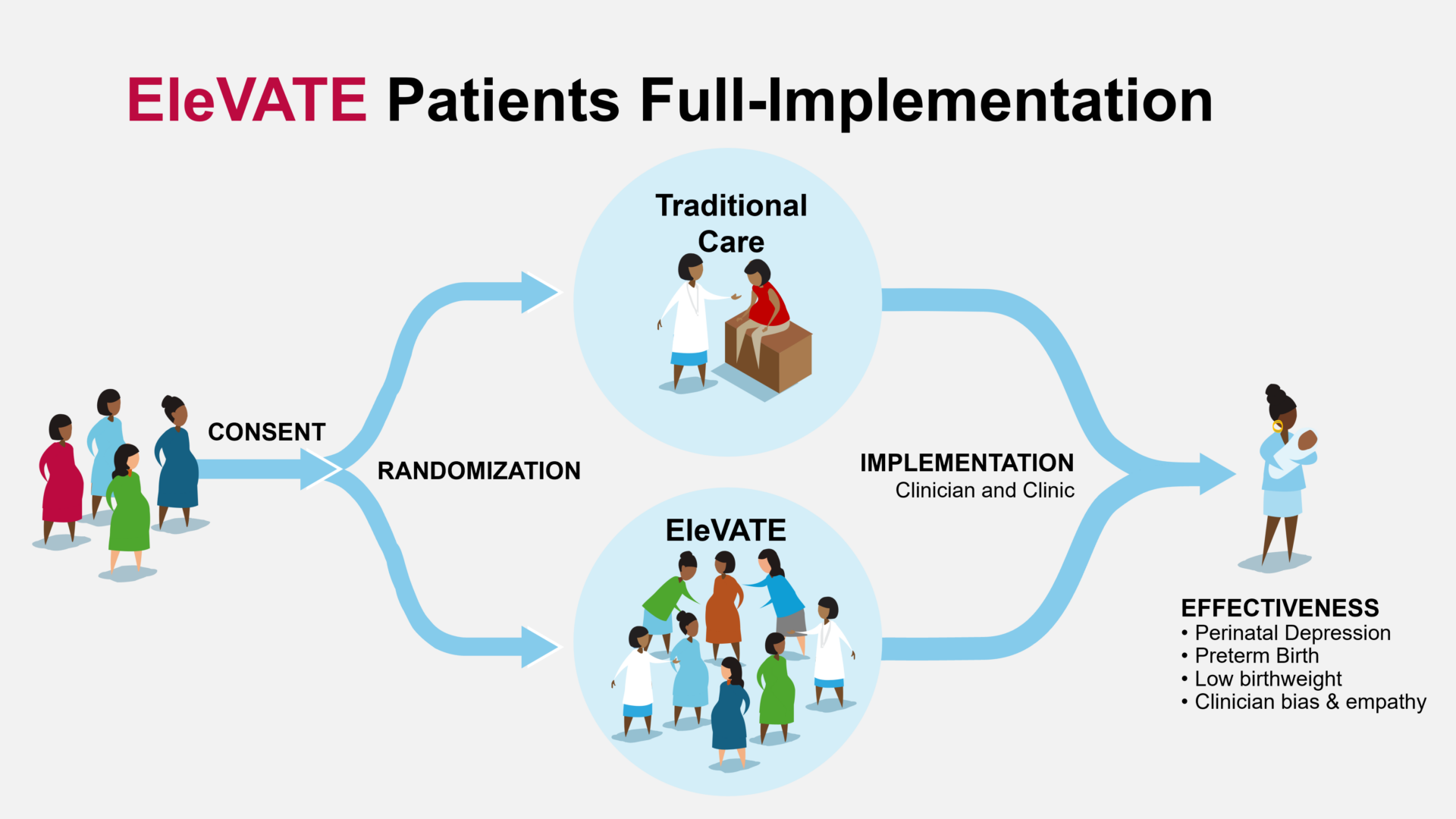
EleVATE conducted a randomized controlled trial. Patients chose whether to consent to the study and were randomly assigned to traditional prenatal care or EleVATE group care. Throughout, patients completed surveys and could choose to take part in a qualitative interview.
WHAT WE FOUND
The women behind the results
Our National Institute of Mental Health trial compared EleVATE group prenatal care with traditional one-on-one prenatal care.
Here is what changed for moms.
OUTCOME
60% less likely
to screen positive for postpartum depression.
OUTCOME
72% lower risk
of postpartum depression for higher-risk moms.
Plus less anxiety, fewer PTSD symptoms and lower stress than traditional care.
Who took part
307 pregnant moms took part, and 205 joined EleVATE groups.
About 6 in 10 EleVATE moms were Black, and 3 in 4 had public insurance like Medicaid.
About 1 in 5 came in with a history of depression.
The work ahead
A New Beginning
The conclusion of our 2025 National Institute of Mental Health study marks a meaningful beginning, not an end. We now have the scientific proof that EleVATE guides the way in reducing postpartum depression and nurturing maternal mental health.
Rooted in this evidence, the Collaborative is ready to expand our reach. Alongside Black and Brown mothers and birthing people, we will continue to center community needs and champion innovative approaches that expand access to care across Missouri and beyond.
We invite you to walk this path with us—because when we elevate community voices, anything is achievable.
Through partnership and collaboration, the St. Louis Integrated Health Network is a healthcare intermediary building capacity across sectors to advance health equity and improve wellbeing by increasing access to health and social services, with an emphasis on communities that have been historically excluded.